

Biographies are better than self-help
Read for transformation, not information

For centuries, Plutarch’s Parallel Lives was the second bestselling book in the Western world after the Bible.
Not a theology. Not a philosophy. Not a manual.
A collection of forty-six biographical portraits, pairing Greek heroes with Roman ones, written explicitly to instruct the reader in how to live.
Shakespeare quarried it for his Roman plays. Montaigne kept it at his bedside. The American founders read it like a field manual. For roughly fifteen hundred years, the smartest and most ambitious people in the world agreed that the fastest path to wisdom ran straight through other people’s lives.
Then, in 1937, Napoleon Hill published Think and Grow Rich, and we decided we could do better than biographies.
We have been paying for that decision ever since.
The self-help industry now generates over ten billion dollars a year, and by most measures—loneliness, purposelessness, the quiet desperation that Thoreau diagnosed before any of it existed—we are no clearer on how to live than we were before.
The books promise transformation and deliver information. You finish them feeling briefly lit up, like a match struck in a dark room, and then the room goes dark again. The problem is not that the authors are wrong.
The problem is that principles, however sound, cannot do what a story does. And what a story does is something we have almost entirely forgotten.
The midwit trap of self-help
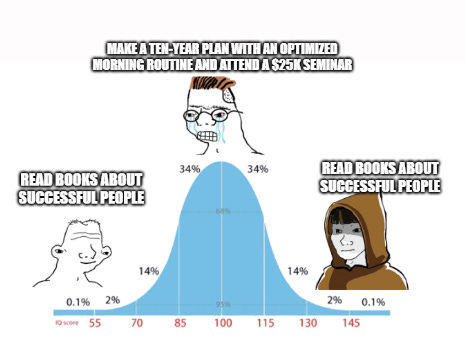
There is a moment, if you have ever been truly absorbed in a biography, where something strange happens. You stop reading about a person and start thinking as them.
You are in the room where the decision gets made. You feel the pressure they felt, the absence of good options, the weight of choosing anyway.
Researchers who study this phenomenon call it narrative transportation. It’s the measurable psychological state in which a story pulls you so completely out of your own frame of reference that you temporarily inhabit someone else’s.
What they have found is that this is not merely an aesthetic experience. It produces genuine, lasting shifts in how people think and behave. The story doesn’t just inform you. It restructures you.
Self-help cannot do this.
A principle or strategy sits outside you, waiting to be applied. A story pulls you inside it.
When you read that Walt Disney rose before dawn as a boy to trudge his paper route through a Missouri winter, bullied by a father who kept the wages and called it character-building, and then you watch that same boy spend the rest of his life constructing an imaginary world no one could take from him—you don’t receive principles about resilience. You watch resilience being built, from specific materials, under specific pressure, in a specific person.
In other words, you see the causality. And seeing the causality changes what you believe is possible, because you’ve witnessed it assembled from the same raw material you’re made of.
Self-help skips the causality. It hands you the conclusion like be resilient, think long-term, embrace failure, and asks you to install it like software.
But character is not software. It is scar tissue. It forms slowly, under friction, in response to specific experiences. When you read a biography, you watch it form. That watching is the education.
The deeper secret, though, is one that the 20th century’s obsession with science and mathematics lost. The most useful biographies ever written were never intended as history.
How could an inaccurate account of someone’s life possibly be useful?
When Xenophon wrote about the life of Cyrus the Great (the Cyropaedia) he almost certainly invented large portions of it.
Xenophon wasn’t a journalist. He was a soldier and philosopher who wanted to answer a question: what does ideal leadership look like, rendered in flesh and decision rather than abstracted into principle?
But his book shaped Scipio Africanus, Julius Caesar, Thomas Jefferson, and Machiavelli. Its historical inaccuracies are essentially irrelevant, because history was never the point. Instruction was.
Plutarch said as much himself — he paired his Greeks and Romans to hold up mirrors in which his readers might recognize what greatness demanded of a person, and decide whether to demand it of themselves.
We lost this when we decided that all history should be a science.
The 20th century, rightly proud of its empirical methods, applied them everywhere, including to the past. Biography became a discipline of accuracy — footnotes, primary sources, the debunking of myths. What we gained in precision we lost in usefulness, because the myths, it turns out, were doing something the footnotes cannot.
Myths operate at the level of pattern rather than event. A fact tells you what one person did once. A myth tells you what humans do under certain conditions, always.
J.R.R. Tolkien spent much of his scholarly life arguing that a story can be more true than a fact precisely because it reaches below the surface of events to the deep structure underneath. He was right, and the biographical tradition understood this long before he said it.
This is why Napoleon modeled himself after Caesar. Caesar modeled himself after Alexander. Alexander modeled himself after Achilles. Achilles never existed.
The chain of human greatness runs, at one end, directly into myth — and rather than undermining the chain, this fact explains its power. Alexander didn’t need a historically verified Achilles. He needed a vector. A direction to aim. An image of human possibility rendered so vividly that it pulled him forward into his own life.
He read the Iliad the way a compass is read: to orient himself within his terrain.
Of course, the objection writes itself: isn’t this just hero worship? Aren’t we endorsing sanitized myths, great-man narratives, the airbrushing of genuine moral complexity?
The answer is no. The confusion here is about the level at which biography operates when read as a model. You are not downloading a person. You are extracting a vector.
Aristotle had a word for the person whose life functions as an aspirational target: megalopsychos, the great-souled one.
The great-souled person is not a saint. They are someone whose courage, ambition, and commitment to their own excellence function as a magnetic north for people trying to find their own direction.
Alexander burned Persepolis.
Disney could be ruthless and controlling.
Churchill was an imperialist who held views we would find repugnant.
None of that invalidates the vector. A basketball player who studies Michael Jordan’s footwork does not become responsible for Jordan’s treatment of his teammates. The model and the man are separable, and knowing which one you’re after keeps you from the twin errors of uncritical worship and reflexive dismissal.
Over time, biography builds something self-help can’t: an index of lives.
Read enough of them and you accumulate a private repertoire of templates. These are not rules, but patterns of human behavior under pressure that you can reach for when your own experience runs out.
How did Lincoln lead a country through tremendous suffering?
How did Alexander hold his men’s loyalty when they mutinied?
What did Disney believe, in the years when his studio went bankrupt and his brother had to manage his nervous breakdown, that made him keep building anyway?
The person who has lived inside enough biographies to ask questions like these has access to a kind of distributed wisdom that no single self-help book, however good, can manufacture.
1. Read for pressure, not achievement
Most people read biography by scanning for the highlights, the breakthroughs, and the moments of triumph that confirm the subject’s greatness. These are the least useful parts.
What you want are the moments of maximum pressure—the decisions made with no good options, the years of failure before the turn, the private moments where the person had every reason to stop and chose not to.
This is where the model lives.
Disney’s defining revelation is the opening of Disneyland, yes — but the years before it tell you everything. The bankruptcy, the nervous breakdown, the studio he lost to a distributor who stole his character, and what he reached for in those years to keep moving.
When you find those moments in a biography, slow down. Sit with them. Ask what the person believed about themselves, their work, or life that made that choice possible, because that belief is what you are actually there to find.
2. Build your index deliberately
A single biography is a single instrument. What you are building, over years of reading, is an orchestra.
Read across eras, domains, and temperaments. Yes, read about founders and conquerors, but also read about scientists, artists, saints, and criminals.
Each life adds a new pattern of human behavior under pressure that you can recognize and reach for when your own situation calls for it.
The goal here is mental fluency: the ability to look at a problem you face and hear, somewhere in the back of your mind, the echo of someone who faced something structurally similar and chose a direction.
You cannot rush this fluency. It is the compound interest of years of reading, and it pays out exactly when you need it most — in the unscripted moment, under real pressure, when no pre-packaged framework fits.
3. Read for instruction, not information
Many old biographies (especially ancient ones) were written as a form of character development.
Plutarch was more interested in ethics than exact facts and used history as his raw material. When he paired Alcibiades with Coriolanus, or Alexander with Caesar, he wanted to show his readers what ambition unchecked by virtue produces, and what ambition yoked to it can build. Read with that same intent.
This doesn’t mean you should read only ancient biographies, but consider why you are reading.
The question to carry into every biography is: what does this life teach?
This reframes how you choose what to read. An older biography, written explicitly as moral instruction rather than academic record, is often more useful for your development than a modern one that buries the model under the footnotes.
In older biographies, the author likely had the same purpose you do — they wanted to produce something in the reader. That shared purpose makes them, across centuries, your collaborator.
Start today
For most of history, the highest achievers have self-educated by reading biographies. Now it’s your turn.
You are looking for a person you can borrow — someone whose spirit you can carry into the parts of your own life that need it most. They are waiting for you on the shelf.